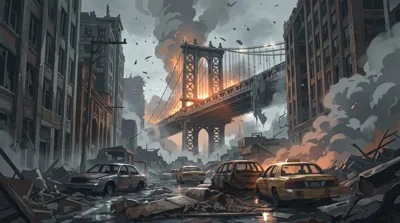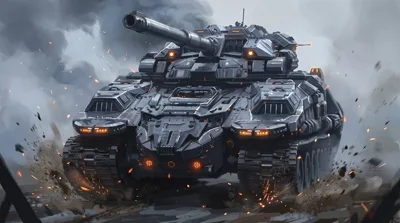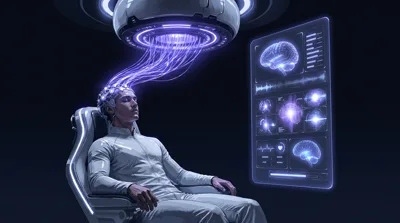
A mystery fog rose over the old world and loosed monsters no army could clear. What survived did not rebuild a civilization. It built a sorting machine, and called it paradise.
where the soul is not sacred, but a file — movable, deletable, overwritten
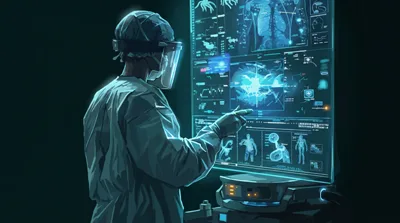
To outpace the monsters, humanity embedded ever more technology into flesh — until the flesh broke under it, and cyber-psychosis spread through the enhanced like a fever. One war-doctor found the cure: edit the embedded memory, shut down the hormonal cascade, and leave the patient in a controlled stillness — alive, functional, and flat.
But the cure carried a larger and more terrible idea with it. If a self can be edited to stillness, then the self is not sacred. It can be cut, moved, deleted, rewritten. Everything in the Silver Empire descends from that single premise.
A cybernetic makes a body stronger, faster, more. A core is something else — a graft of human engineering onto the incomprehensible substance of the fog itself. Cores do not improve a person; they rewrite the rules for that person. And because every core carries a piece of the monster no one can fully understand, every core carries an unknowable cost. Even the man who built them cannot fully vouch for what they do.
A god, here, means something exact: a mortal mind that can withstand the psychosis — the madness inflicted by a core, or by a cybernetic load pushed to its absolute maximum. Most minds shatter. A god is simply one that held at the limit. Godhood is not power, nor divinity, nor deathlessness. It is only this — a self that survived being pushed past the edge, by whatever means, and at whatever cost.
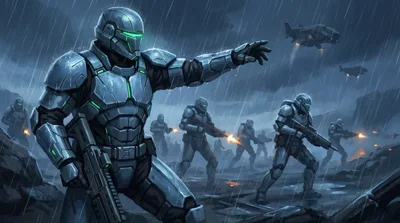
an apocalypse humanity could have survived — and bankrupted itself fighting
Not to the monsters. To the bill — and beneath the bill, to a brittleness no one had noticed. By the time the fog came, humanity had reached the age where everyone held a big gun: total mutual lethality, every power able to end every other. No one wanted war, so the whole order ran on enforced politeness — the careful deference of people too dangerous to offend.
It held so long that politeness became the only thing anyone knew how to do — a peace with no shock absorbers. Then a small country was actually allowed to fall, and Albion (old England) refused the bill. The trouble was not that the refusal was world-ending. It was that a civilization addicted to decorum could not process a small nation dying while another played accountant.
They had built a world of manners precisely so no one would ever have to watch this happen; when it happened, there was no protocol — only the arsenal beneath the manners. Rhinemark (old Germany) burned Lunden not because the loss was strategically fatal, but because the breach of decorum was unthinkable, and when everyone holds a big gun, decorum is the only thing keeping the guns down.
humanity tried to manufacture salvation — and went to war over the bill
After the first god held, the world tried to build one on purpose. Helvet (old Switzerland) — neutral ground, the banker's nation — raised the second, funded by everyone, the small nations among them, all paying into a common defense. And when it woke, it took the core, fell into psychosis like all of them, opened its empty eyes upon the room, took a single turn — and snapped its own neck.
Conscious for seconds, with no people yet to love and no duty yet to bind it, a clear mind looked once at what godhood was and chose the door before anyone could give it a reason not to. It is the proof every god alive now carries: the door opens. Someone walked through it. The others endure only because they were given reasons to keep spinning before they could think clearly — and they all know the name of the one who wasn't.
Then came the war, over money, as the first collapse had been. Albion refused the bill. Rhinemark finished Lunden and built the V3 out of vengeance — and it died on the same city it was made to avenge. Sultheim (old Brunei) bought a hollow god from Volkov (old Russia), and a Cat-3 from the sea ended him in twenty minutes. Vrana (old India), lacking the means to power a core, tried to brute-force one with raw nuclear, and detonated itself into a crater. The institutions produced a suicide and a war. It would take an accident, alone in a forgotten lab, to produce the strongest being mankind has known.
a chronology kept from the Founding — because the fog and the godding ate the rest
The Sleepless do not count their age from birth. The fog blurs time, and the godding itself takes memory — each transformation scrapes pieces of the past away. None of them can reliably reach the beginning of themselves. So they count from the Founding: the year the fog thinned and the refuge held. Everything before is what memory could not keep.
how an abandoned squad became an empire — in three monster attacks
It began as a ghost op — a spec-ops envoy hauling a bomb from one city to another, the squad briefed on nothing. A Category One monster hit them in the wasteland. They called homebase. Homebase answered with one word — godspeed — and wrote them off for dead.
The word was no accident. The squad was mostly the blood the panic had deemed expendable: Ghost, Reap, Arma, Walter — and the two blood brothers, Silver and Xerxes, who had been counted among the spared. Godspeed came for them all the same, because a failed op honors no distinction. The empire would be built by the people a nation threw away, gathered up by the two who weren't, in the one lab where the sorting finally stopped mattering.
Each monster they could not stop cost one more brother his wholeness. One soldier's psychosis spiked under the load; Silver edited him into Ghost. Another, Reap, lay dying; Silver fused monster and tech for the first time to keep him alive — the first core ever made. Years later a second apex came that they could not kill, and with the community about to die again, Silver performed his final edit — on himself.
He is not the first god. He is nearly the last, and the only one born of accident. The deliberate, funded, sanctioned gods had failed — the committee's god killed itself, the vengeance-god died on Lunden, the world went to war over who would pay. Then a war-doctor, alone in a forgotten lab, with no funding and no committee, did the thing the great projects could not.
a family, measured in feeling — arranged by how much of themselves the war let them keep
Before the fog, a sunny boy who thought too much. As a teenager he watched the whole god-race play out on the news — the Helvene suicide, the unpaid bill, the fall of the Concord — and absorbed every failure. A war-doctor by the time the envoy flipped, he cured cyber-psychosis by learning to edit the mind into stillness, and in doing so discovered the premise the whole empire rests on: the self is a file.
When a second Cat-1 came that they could not kill, he made his final edit on himself — cutting his own brain down until there was less of it to shatter, so he could hold the load and fire the shot. Becoming the god and killing the monster were one act.
He is not the first god, but he's the only one born of accident, and the most trapped of all: a lucid mind in a god's body reaches for the neck, so he removed the lucidity that would reach and handed the kill-switch to Xerxes. He doesn't sit a throne — he's diffused into the city's governing intelligence, the hum, always listening. He kept his name. He cannot feel the cage he's locked inside.
Fully edited, fully flat — the empire's hand beyond the fog, the intel man who topples nations from within. Carries a katana on his arm and chooses it over a gun because the blade is silent and close.
His Soul Core doesn't move his body; it deletes him here and restores him there. The memory always survives the crossing — whether the man does, no one knows, not even Silver, who could only verify the memory transferred, never the person. So he's named Ghost: possibly the ten-thousandth perfect copy of a man who died in the lab, each lasting exactly one blink.
He always wears a full-face mask, and no one ever checks whether anyone is behind it. He was edited first — flat before he was armed — because you don't give the soul-deletion core to a man who can still fear death. The emptiness is almost a kindness. He lost his name to his blade.
Fully edited. The commander of the armed forces made into a wall — a gravity cannon on one arm, an enormous sword in hand. He was the driver of the envoy when it flipped; the man who lost control of the vehicle that ended the old world is now the thing nothing can push.
His Gen 1 Core was the first ever made, fused in panic to keep him from dying — the crudest, least-leashed graft of monster and tech. It grants no clever power, only raw pressure: 强龙压, the strong dragon pressing down, a presence so total that bodies near him fail before minds decide anything.
But because the monster in it was never tamed, it misfires — run hard, it overloads into a roar that crashes his own allies' systems alongside the enemy's. His ultimate weapon is a coin-flip between victory and felling his own men, so he holds it back and fires it last. The man who crashed once is defined again by a power he can't control. His name is a codename no one can expand.
The partial edit. Most of him survived intact — he still feels, still cracks jokes, carries more empathy than anyone in the family, though he doesn't look it: a big man in a thick fur coat with modded sniper's eyes.
The one thing Silver successfully cut was anger, and it didn't vanish so much as misroute — Arma feels anger as sadness, every spark that should flare into rage collapsing inward into grief. With no anger, he had no reason to fight, so he became overwatch: sits above it all and does little, because he doesn't want to kill again.
His Giant Core resizes his rounds to monstrous scale — a single bullet through a skyscraper, a guaranteed kill — and it belongs to the one brother who can still feel what it does; when he fires it, he needs therapy after. It runs his metabolism low, so he's always slightly huge and always cold, freezing from the inside, which is why the coat never comes off. The only soldier in the family human enough to be tired of it. He kept his name.
The one who was never edited — the only normal man among them, and the proof of what the others were before. He was the junior tech in the envoy, a boy of sixteen who'd joined the war for the most human reason in the whole story: he was looking for his father. They found him — the corpse.
Walter is the only brother who got to grow old; he aged a full mortal life, sixteen to eighty-one, and was dying an old man when Silver saved him. The others were frozen mid-war; Walter knew what a whole life felt like and remembers being old beneath the young face he wears now — a loneliness none of them share.
His Seed Core, built when he was dying at 81, was the breakthrough that finally made a core stable. It grants almost nothing — long life, youth restored to about twenty-one — but it's the base every later core descends from. The whole immortal family traces back to the day Silver refused to let a dying old friend go. The kindest act became the root of everything. He keeps Argent's body alive and the founding lab still running.
Silver's blood brother, younger by two years — the quiet, book-smart boy to Silver's bright one, the last living soul who remembers Silver's true face. When the cybernetics took him, Silver couldn't bring himself to edit his brother, so he gave him a Silver Core to bear the load and stay himself. Neither knew the Core carried immortality. The mercy became a sentence: Xerxes feels everything, forever, and carries the grief his brother amputated for them both.
He's the world's last library — every human tongue, nine centuries of history, his family's lost pasts, all held whole — and the one file he cannot retrieve is himself. His name isn't his name; it was a war-tech company logo, the last thing his eyes registered as they stopped being eyes. He's worn a brand for nine hundred years.
He's the one who rendered the verdict on Silver's transformation — success — because he was the only one left with the feeling to measure against. "He saved everyone. And he is gone. They are the same event." He knows that line is true, holds it, and doesn't say it.
The more a brother was erased inside, the more his name tends to have been erased too — with two heartbreaking inversions. Walter kept everything, and his name, and still grieves. Xerxes kept everything and lost his name anyway. The two unedited brothers are the two who still hurt; the war took a name from one and let the other keep his, with no justice to it at all.
the money that exists because everything was first reduced to it
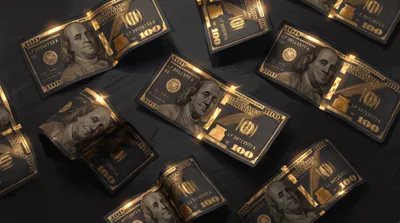
For nine hundred years there was no common coin — until everyone, at last, ran out at once. With nothing left to hoard, hoarding stopped mattering, and a universal currency became possible only through total exhaustion: a clean plate. Its formal name is Credit.
Everyone calls it Dust. The criminal economy — the only one that never stopped running — had already set the standard; the underworld's money simply won.
a catastrophe improvised into a paradise, then frozen for nine hundred years
Argent grew on the bones of old New York, and every district encodes the order of who belongs. The whole map is one mercy split in two: everyone is saved, and everyone is ranked, and the ranking is written in geography so no one has to say it aloud. The sheltered bay for citizens; the beautiful exposed tip for everyone else. The loveliest real estate in the city is also its sacrificial buffer, sold as a perk.
The city does not threaten. It provides — total and unasked, answering needs before they are spoken, until there is no reason left to want. Where the working cities feel like a Tuesday, Argent feels like the loveliest waiting room ever built, and the wait is the rest of your life. When a quarrel flares, a stop comes straight into the skull; you kneel and apologize, your body bending before your mind agrees. It is not peace. It is suppression in a velvet voice.
Silver tolerates nearly everything: drugs, arms, laundering, illegal cybernetics — all of it commerce, taxed, not punished. There is exactly one thing he will not tolerate, fatal on the spot with no appeal for blood or station: the owning of people. It is the crime that touches the founding wound. He cannot feel its horror — he edited that capacity away centuries ago — and he executes it anyway, flatly, the way he answers a question about rainfall. It is the one place the feelingless thing acts like it is furious, and it is not furious. It is simply certain.
some questions are sealed open — the wound at the center of every god
The cores are fused with the fog's own flesh. There is monster inside the Sleepless — measurably, inseparably, the very thing that makes them what they are. So: are they humanity's defenders, or the fog's first success? Silver cannot answer it, and cannot feel anything about it. Xerxes, who carries the same apex and feels everything, can ask — and cannot sleep for it. The question is sealed open, and the codex keeps it that way.